U.S.-Pacific Treaties: Oceanic Transit Rights Impact
Renewed U.S.-Pacific Island diplomatic treaties significantly redefine international transit rights across three crucial oceanic corridors, influencing global maritime security, trade routes, and regional geopolitical dynamics.
The intricate world of international diplomacy constantly reshapes global interactions, and few areas are as vital as maritime transit rights. The recent renewal of U.S. Pacific Transit treaties with several Pacific Island nations marks a pivotal moment, poised to profoundly influence navigation and access across three critical oceanic corridors. This development isn't just about sovereignty; it's about the very arteries of global commerce and security.
Understanding the geopolitical landscape of the Pacific
The Pacific Ocean, a vast expanse covering nearly a third of the Earth's surface, has long been a theater of strategic importance. Its countless islands, rich in culture and biodiversity, sit atop some of the world's most vital sea lanes. For the United States, maintaining stability and fostering strong relationships in this region is paramount, not only for economic interests but also for national security.
Historically, the U.S. has deep ties with Pacific Island nations, rooted in shared history and mutual defense agreements. These relationships have evolved, shifting from post-war aid to contemporary partnerships focused on climate resilience, economic development, and maritime security. The renewed diplomatic treaties underscore a strategic re-engagement, recognizing the growing geopolitical significance of the region.
The evolving role of Pacific Island nations
Pacific Island nations, though often small in landmass, command vast Exclusive Economic Zones (EEZs), granting them significant control over oceanic resources and transit within their territories. Their collective voice in international forums is growing, and their strategic location makes them key players in global maritime governance. These nations are increasingly asserting their sovereignty and seeking partnerships that respect their unique environmental and developmental challenges.
- Enhanced regional stability and security.
- Increased cooperation on climate change initiatives.
- Opportunities for sustainable economic development.
The renewed U.S. focus acknowledges these nations as indispensable partners, moving beyond a purely transactional relationship to one built on shared values and long-term commitment. This approach aims to counter growing influence from other global powers and ensure a free and open Indo-Pacific.
In essence, the geopolitical landscape of the Pacific is a complex tapestry of historical ties, emerging challenges, and strategic competition. The U.S. engagement through these renewed treaties seeks to reinforce its position as a reliable partner, promoting a rules-based international order and ensuring the unimpeded flow of maritime traffic.
The three critical oceanic corridors defined
The renewed U.S.-Pacific Island diplomatic treaties specifically impact transit rights across three oceanic corridors, each holding unique strategic and economic significance. These corridors are not merely lines on a map; they are dynamic pathways for global trade, military movements, and resource exploration.
The first corridor often refers to the routes through Micronesia, connecting North America to East Asia. This area is vital for commercial shipping, facilitating the movement of goods between major economies. The Federated States of Micronesia, the Republic of the Marshall Islands, and Palau, through their Compacts of Free Association with the U.S., play a crucial role in maintaining open access and security in this zone. The treaties reinforce the U.S.'s ability to operate and defend these critical lines of communication.

The second corridor extends through Melanesia, including nations like Papua New Guinea, Solomon Islands, and Vanuatu. This region is rich in natural resources and sits along important routes to Australia and Southeast Asia. While not as directly tied to existing U.S. compacts, renewed diplomatic efforts here aim to strengthen partnerships, enhance maritime domain awareness, and ensure adherence to international law regarding transit. The focus is on preventing illegal fishing and ensuring safe passage for all vessels.
Key features of the corridors
- Micronesian Corridor: Essential for trans-Pacific trade, linking major economic hubs.
- Melanesian Corridor: Resource-rich, crucial for regional trade and security.
- Polynesian Corridor: Bridging the central Pacific, important for scientific research and naval operations.
The third corridor encompasses the vast expanse of Polynesia, stretching from Hawaii down to nations like Samoa, Tonga, and Fiji. This corridor, while perhaps less commercially dense than the others, is strategically important for naval operations, scientific research, and maintaining a U.S. presence across the central Pacific. The treaties help solidify arrangements for port visits, joint exercises, and humanitarian assistance, ensuring operational flexibility for U.S. forces.
Each of these corridors presents unique challenges and opportunities. The renewed treaties provide a framework for navigating these complexities, ensuring that transit rights are respected, security is maintained, and international law is upheld, fostering a stable and predictable maritime environment for all users.
Legal frameworks and international transit rights
International transit rights are governed primarily by the United Nations Convention on the Law of the Sea (UNCLOS), a comprehensive treaty that defines the rights and responsibilities of nations with respect to their use of the world's oceans. While the U.S. has not ratified UNCLOS, it generally adheres to its provisions as customary international law, particularly regarding freedom of navigation and overflight.
The renewed U.S.-Pacific Island diplomatic treaties build upon these existing legal frameworks, often clarifying and strengthening specific provisions related to transit through territorial seas, archipelagic waters, and Exclusive Economic Zones (EEZs). These agreements ensure that the right of innocent passage and transit passage, as defined by UNCLOS, is respected while also addressing the security concerns and sovereign rights of the Pacific Island nations.
Treaty specifics and legal implications
Many of these treaties involve Status of Forces Agreements (SOFAs) or similar arrangements that define the legal status of U.S. military personnel and assets within the host nation's territory and waters. These agreements are crucial for facilitating joint exercises, disaster response, and maritime security operations, all of which rely on predictable transit rights.
- Clarification of innocent passage rules.
- Provisions for transit passage through straits used for international navigation.
- Protocols for military vessel and aircraft movement.
Moreover, the treaties often include provisions for technical assistance and capacity building for Pacific Island nations, enabling them to better monitor and enforce their maritime laws. This not only enhances their sovereignty but also contributes to regional maritime security, combating illegal, unreported, and unregulated (IUU) fishing, and other illicit activities that can impede legitimate transit.
The legal implications extend to commercial shipping as well. By providing greater clarity and stability regarding transit rights, these treaties reduce uncertainty for international shipping companies, potentially leading to more efficient and secure trade routes. This stability is particularly important in regions prone to piracy or other maritime threats.
In conclusion, the legal frameworks underpinning international transit rights are complex, but the renewed U.S.-Pacific Island diplomatic treaties serve to reinforce and operationalize these principles, ensuring a stable and secure maritime environment for all legitimate users of the oceanic corridors.
Economic implications for global trade and local economies
The economic ramifications of renewed U.S.-Pacific Island diplomatic treaties on international transit rights are far-reaching, impacting both global trade networks and the local economies of the Pacific Island nations. Enhanced stability and predictability in oceanic corridors translate directly into benefits for international shipping and commerce.
For global trade, secure and unimpeded transit through these strategic corridors means reduced shipping times, lower insurance costs, and greater reliability for supply chains. This is particularly crucial for industries reliant on trans-Pacific shipping, such as technology, manufacturing, and consumer goods. Any disruption in these routes can have cascading effects on global markets, making the stability fostered by these treaties incredibly valuable.

Impact on Pacific Island economies
Locally, the treaties present a mixed but generally positive economic outlook for Pacific Island nations. Increased U.S. engagement often comes with economic assistance, infrastructure development, and opportunities for trade and investment. Projects related to port modernization, renewable energy, and digital connectivity can significantly boost local economies.
- Increased foreign direct investment.
- Development of maritime infrastructure.
- Growth in tourism and fisheries sectors.
Furthermore, the emphasis on maritime security within the treaties helps combat illegal fishing, a major economic drain on many Pacific Island nations. By protecting their valuable marine resources, these nations can ensure long-term sustainability for their fishing industries, which are often a cornerstone of their economies. The U.S. also often provides training and equipment to strengthen local coast guard capabilities.
However, there are also considerations regarding potential over-reliance on external aid and the need to ensure that economic development is sustainable and culturally appropriate. The treaties aim to strike a balance, promoting economic growth while respecting the unique environmental and social contexts of the islands. The development of sustainable tourism and responsible resource management are key areas of focus.
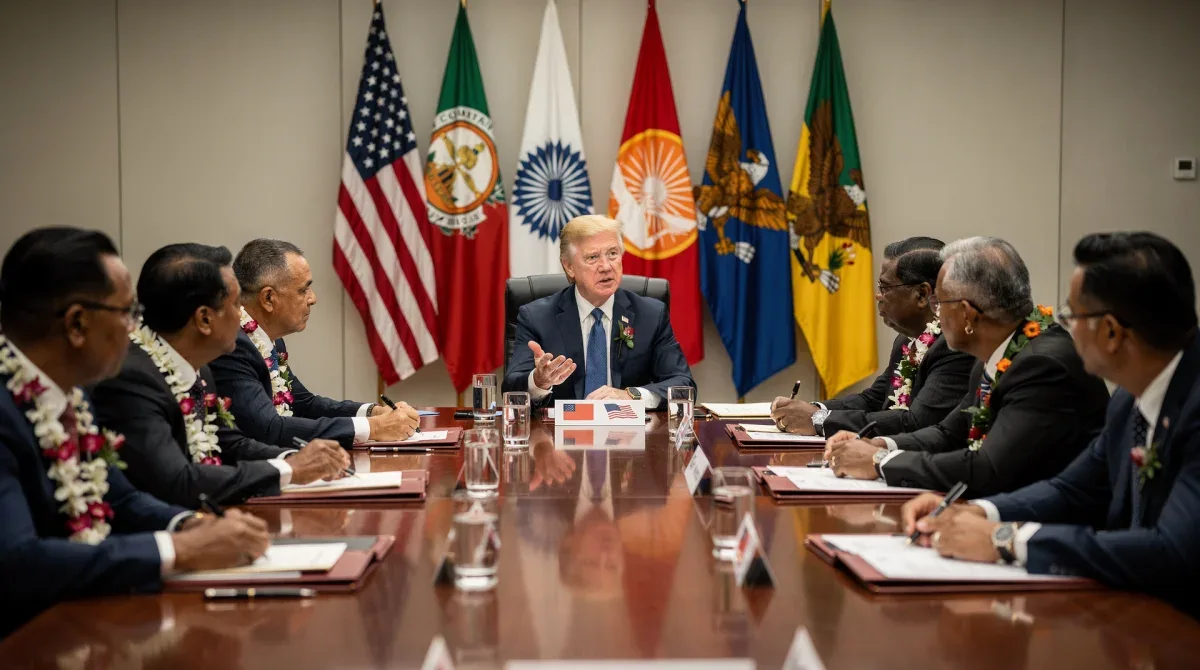
In summary, the economic implications are substantial. By ensuring stable transit rights and fostering development, these treaties contribute to a more secure and prosperous Indo-Pacific region, benefiting both the global economy and the local livelihoods of Pacific Islanders.
Security implications and regional stability
The security implications of renewed U.S.-Pacific Island diplomatic treaties are arguably among the most significant aspects of these agreements. The Pacific region is increasingly a focal point for geopolitical competition, and maintaining regional stability is a shared priority for the U.S. and its island partners. These treaties directly address various security challenges, from traditional military concerns to contemporary threats like climate change and transnational crime.
From a military perspective, the treaties reinforce the U.S.'s ability to project power and respond to crises across the vast Pacific. This includes freedom of navigation operations, joint military exercises, and the ability to rapidly deploy humanitarian assistance and disaster relief (HADR) efforts. By ensuring predictable access and transit rights, these agreements enhance interoperability with regional partners and strengthen collective security.
Addressing emerging security threats
Beyond traditional defense, the treaties also focus on a broader definition of security. Climate change, for instance, poses an existential threat to many low-lying Pacific Island nations, leading to displacement, resource scarcity, and increased instability. U.S. cooperation often includes initiatives to build climate resilience, such as early warning systems and sustainable infrastructure projects.
- Enhanced maritime domain awareness to combat illegal activities.
- Cooperation on disaster preparedness and response.
- Strengthening regional law enforcement capabilities.
Transnational crime, including illegal, unreported, and unregulated (IUU) fishing, drug trafficking, and human smuggling, also presents significant security challenges. The renewed treaties facilitate intelligence sharing, joint patrols, and capacity building for law enforcement agencies in Pacific Island nations. This collaborative approach helps to secure maritime borders and protect sovereign resources.
The overall goal is to foster a rules-based order in the Indo-Pacific, where disputes are resolved peacefully and all nations can exercise their rights under international law. By strengthening relationships with Pacific Island nations, the U.S. aims to create a network of resilient partners capable of addressing shared security concerns and resisting undue influence from external actors. This contributes to a more stable and predictable regional environment.
Ultimately, the security implications extend beyond military might, encompassing a holistic approach to human, environmental, and economic security, ensuring the long-term stability and prosperity of the Pacific region.
Challenges and future outlook
Despite the significant positive impacts, the renewed U.S.-Pacific Island diplomatic treaties and their implications for international transit rights are not without challenges. Navigating these complexities will be crucial for the long-term success and effectiveness of these agreements. One primary challenge lies in the sheer scale and diversity of the Pacific region, requiring tailored approaches for each island nation.
Geopolitical competition remains a persistent challenge. While the U.S. seeks to strengthen its partnerships, other global powers are also actively engaging in the Pacific, creating a dynamic environment where allegiances can shift. Maintaining consistent and impactful engagement will be vital for the U.S. to solidify its role as a preferred partner. This involves not only security cooperation but also substantial economic and developmental assistance that truly benefits the local populations.
Ensuring equitable benefits and long-term sustainability
Another challenge involves ensuring that the benefits of these treaties are equitable and contribute to the long-term sustainable development of Pacific Island nations. Concerns about sovereignty, environmental protection, and the preservation of cultural heritage must be central to all engagements. The treaties need to be perceived as genuine partnerships, not just strategic maneuvers.
- Addressing climate change vulnerabilities effectively.
- Balancing strategic interests with local development needs.
- Ensuring continuous and sustained diplomatic engagement.
The future outlook for these treaties is largely dependent on consistent implementation and adaptive diplomacy. The U.S. will need to demonstrate sustained commitment, moving beyond initial agreements to tangible, impactful projects and ongoing dialogue. This includes supporting climate adaptation efforts, investing in sustainable infrastructure, and fostering educational and cultural exchanges.
Furthermore, regional cooperation among Pacific Island nations themselves will be crucial. Strengthening regional organizations and fostering a collective voice will empower these nations to advocate for their interests and effectively engage with global partners. The U.S. can play a supportive role in facilitating this regional cohesion.
In conclusion, while challenges exist, the renewed U.S.-Pacific Island diplomatic treaties offer a promising framework for enhancing international transit rights, promoting regional stability, and fostering sustainable development. The future success hinges on genuine partnership, consistent engagement, and a commitment to addressing the evolving needs of the Pacific region.
| Key Impact Area | Brief Description |
|---|---|
| Maritime Security | Enhanced U.S. operational flexibility and regional cooperation to combat illicit activities and ensure safe passage. |
| Global Trade Routes | Increased predictability and stability in key oceanic corridors, benefiting trans-Pacific shipping and supply chains. |
| Regional Geopolitics | Strengthened U.S. influence and partnerships in the Pacific, countering competition and promoting a rules-based order. |
| Local Economies | Potential for increased aid, infrastructure development, and protection of marine resources for island nations. |
Frequently asked questions
What are the three oceanic corridors mentioned in the treaties?▼The three corridors broadly refer to maritime routes through Micronesia, Melanesia, and Polynesia. These areas are strategically vital for international trade, military movements, and resource exploration, connecting major global economies and facilitating regional stability and security.
How do these treaties impact international shipping?▼These treaties enhance predictability and stability for international shipping by clarifying transit rights and bolstering maritime security. This can lead to reduced shipping times, lower insurance costs, and greater reliability for global supply chains, benefiting industries reliant on trans-Pacific routes.
Do these agreements affect the sovereignty of Pacific Island nations?▼The treaties aim to reinforce, not diminish, the sovereignty of Pacific Island nations. They often include provisions for capacity building, allowing nations to better monitor and enforce their maritime laws, protecting their resources while respecting international transit norms.
What role does UNCLOS play in these renewed treaties?▼While the U.S. has not ratified UNCLOS, it generally adheres to its principles as customary international law. The renewed treaties often build upon UNCLOS provisions, clarifying and strengthening specific rules regarding transit through territorial seas, archipelagic waters, and Exclusive Economic Zones.
What are the main security benefits for the Pacific region?▼Key security benefits include enhanced U.S. response capabilities, improved regional cooperation against transnational crime like illegal fishing, and joint efforts in disaster preparedness. These strengthen collective security and promote a rules-based order across the Indo-Pacific.
Conclusion
The renewal of U.S.-Pacific Island diplomatic treaties represents a critical juncture for international transit rights across the Pacific's strategic oceanic corridors. These agreements are not merely symbolic; they are foundational to fostering stability, ensuring economic prosperity, and addressing complex security challenges in a region of growing global importance. By reinforcing international law, promoting sustainable development, and strengthening partnerships, these treaties pave the way for a more secure and predictable maritime future for all.
